Professor Róbert Kiss: The Hungarian Brochures And Taiwanese Mochi
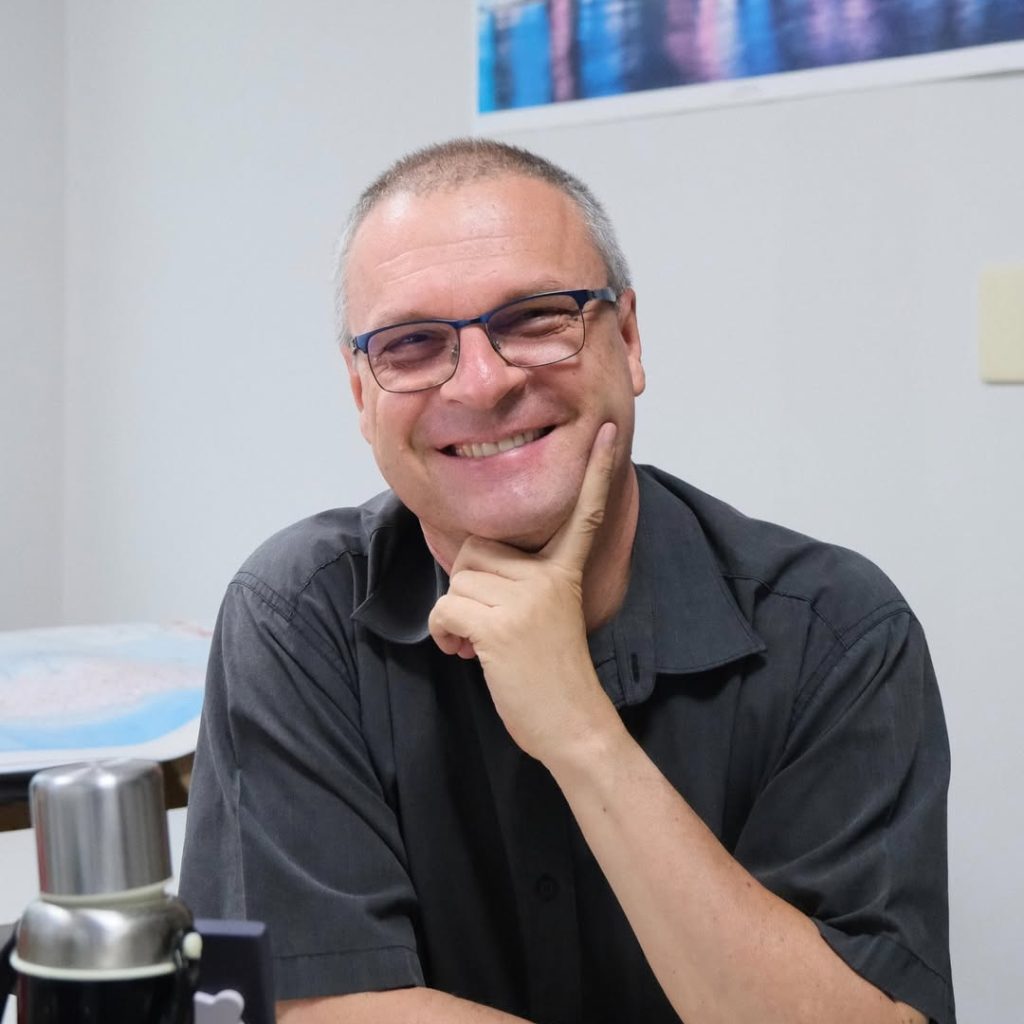
In a room piled high with papers, books, and souvenirs, Professor Róbert Kiss sat in the same chair he had occupied for nine years.
When we arrived, his office door was wide open. He paused from writing in his planner to welcome us with Taiwanese mochi he had bought on a trip, while we stood in amazement at the souvenirs neatly arranged on his floor-to-ceiling shelves.
Replying to all the curious questions with a smile, he began to recount his story, the path that led him from a Head Teacher in Budapest to an Intelligent Tourism and Hospitality Management Assistant Professor at I-Shou University, Taiwan.
Life Is Full of Turns And Twists
If you asked the younger version of Professor Kiss if he wanted to be a teacher, he would say “no”. Back then, he was busy climbing up the ladder toward becoming a DMO Manager in Hungary. But once he reached that position, he decided: “Well, that’s it.”
He took a turn and got his joint Master of Education at Glion Institute of Higher Education with Endicott College in Beverly, Massachusetts. He also pursued a Ph.D. in Tourism Geography – Golf Tourism at University of Pécs (Hungary). After that, he taught at Kodolanyi Janos University of Applied Sciences and then at Budapest Metropolitan University (Hungary), where he later became Head of School, School of Tourism, Leisure and Hospitality.
While working in Hungary, he was introduced to I-Shou University in Taiwan by a friend. “I know about Taiwan: the OEM factories and the Taiwan Miracle… I have met classmates coming from East Asia. So I was curious and I wanted to explore the region deeper than just its economy.” He explained the reason why he accepted the job offer.
Then, he beamed and revealed the twist: “But by the time I arrived, my friend had already left.”
We all laughed along.
At that time, Professor Robert Kiss was no different from us, the “lonely” international newcomers.
Making Taiwan “The Second Home”
Adapting to a new place was definitely not easy. Professor Róbert Kiss’s first year was far from smooth; he struggled to adjust to Taiwan’s education system and students’ learning styles. But once the difficult stage passed, he began to find comfort and peace. He grew to love his teaching life.
“This is from the coffee class.” He stood up just to show us the pictures. “And that is the graduation photo of my students.” Next to them were gifts and souvenirs from all over the world. Some are from his business trips, others are given by students.
Outside of teaching, he also spent time exploring Taiwan. “There was a time I traveled with Dr. Patev one day after a typhoon. I was impressed by how well-organized this country was,” he recalled. “Just after the typhoon, transportation and tourism were already back to normal.” The city was cleaning up, while people and tourists filled the streets as if nothing had happened.
Not only how Taiwanese people handled the typhoon impressed him, but also how calmly they reacted to the pandemic. These experiences deepened his admiration for Taiwan’s adaptability, which later became one of the inspirations for his research on how this island’s tourism industry was transformed by COVID-19.
Taiwan’s Tourism As A Subject Of Research
Since moving to Taiwan, Professor Róbert Kiss has collaborated with both Taiwanese and international scholars, producing research that examines this island’s tourism industry.
One study, “Quarantine Hotel Experience: Travel Diaries of Confinement,” explored how mandatory 14-day hotel quarantines in 2021 affected travelers’ emotional, psychological, and physical well-being. He also co-authored a book chapter, “Taiwanese Hazard Management of Typhoons and Their Impact on Tourism,” which looked at how Taiwan’s tourism system responded to natural disasters
More recently, with Dr. Plamen Patev and Dr. Kou Wei Lan, he published “The Impact of COVID-19 on Domestic Travel: The Spatial Changes in Taiwan.” The research analyzed five years of tourism data, revealing that domestic trips initially dropped sharply in early 2020. Yet during the Bubble period (May 1, 2020 – April 30, 2021), strict border controls and a virus-free domestic environment allowed life to continue mostly normally, and domestic travel rose 16% above pre-COVID levels.
Nature spots and lively cities became popular again, while Taipei, New Taipei, and industrial areas saw fewer visitors. Later, when outbreaks hit, tourism dropped sharply by 60%, but it bounced back quickly. By 2023, tourism’s revenue was more than pre-COVID-19, even though there were still fewer travelers overall.
“The Hungarian Ambassador”
Sitting back in his chair, Professor Kiss looked around the room, which was over 5000 miles away from his home country. “I’m going to celebrate my 10th year here,” he said, while his eyes were drifting as if looking into the past.
Still, his thoughts often returned to his beloved Hungary.
As our interview came to an end, he handed us a stack of brochures about Hungarian tourism and education. It is a small reminder of the home he carried with him, jokingly earning him the title “Hungarian Ambassador”. (He also generously gave us all the Taiwanese mochi.)
And in that moment, it was clear that his life had become a bridge between two worlds, two cultures. Years of challenges, discoveries, and connections had woven together into a story of growth and exploration, of a man who had ventured beyond familiar borders and, along the way, left a mark on the people around him.
Taiwan became my second home. It challenged me, shaped me, and gave me a new purpose.
Dr. Róbert Kiss