Professor Ching-Yi Tien: Nurturing Voices Through Media and Language
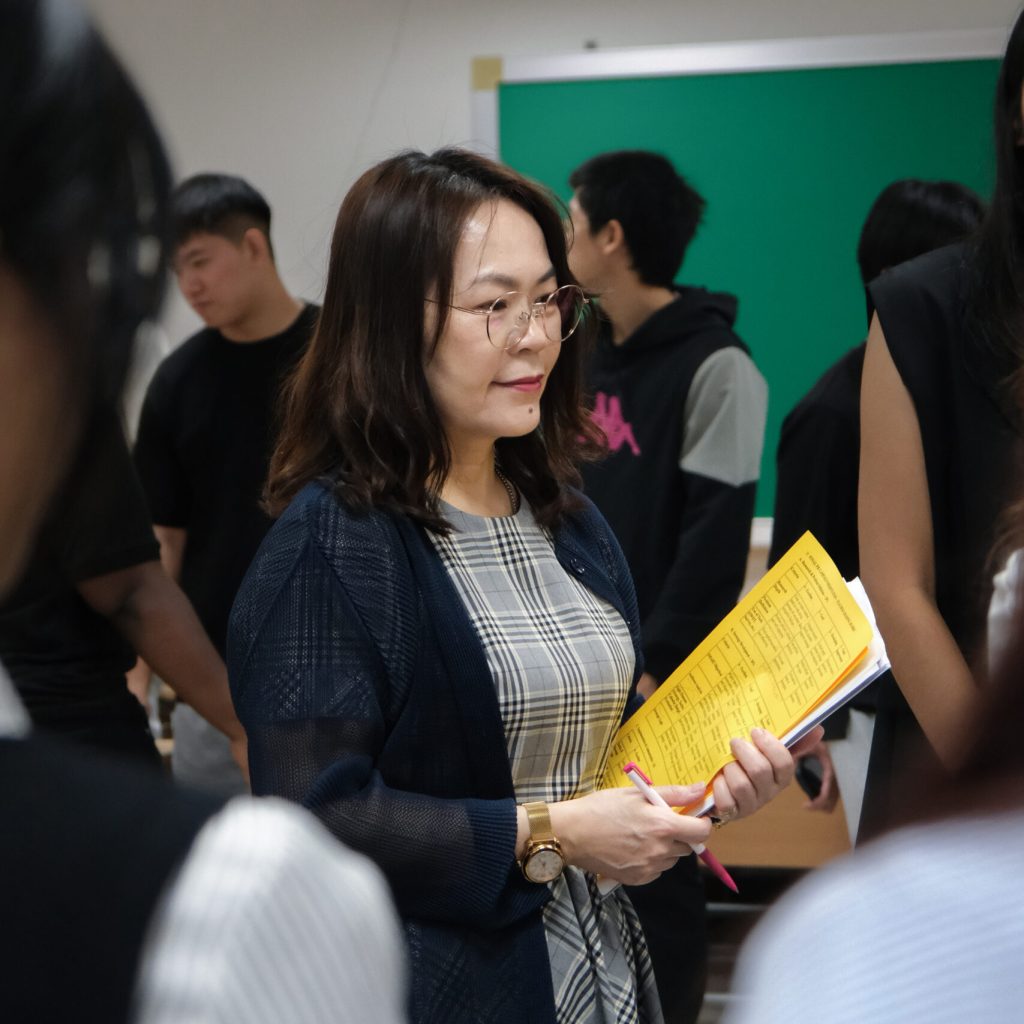
In the noisy hallway, Professor Tien walked down, balancing a stack of A1 papers and crayons with effortless grace. At the classroom door, students welcomed her with excitement, buzzing with curiosity about the day’s activity. With her usual cup of coffee in hand, she greeted each student warmly. A quiet smile on her lips hinting that today’s lesson was about more than just facts or information.
Her classroom has always been an open space of ideas exchange across languages and cultures, a skill that, in her hands, seemed almost an art. Watching her, we wondered how she had come to teach with such gentle authority. So we were eager to sit down and interview her to understand the insights that had shaped her path.
The Weaving Threads Of Communication, Linguistics And Education
Several years ago, Professor Ching-yi Tien started her academic journey with a Bachelor of Arts in Mass Communication at the University of Oklahoma, USA, followed by a Master of Arts in English Language Teaching at the same university. After returning to Taiwan, she unexpectedly discovered a genuine love for teaching. This realization led her to pursue a PhD in Applied Linguistics and English Language Teaching at the University of Leicester, in the UK.
Along the way, she taught at several universities, directed language centres, and led English-Medium Instruction (EMI) development teams. Today, at I-Shou University, she weaves her expertise in language, media, and cross-cultural communication into her teaching and research.
Expressing Across Formats and Languages
At the heart of Professor Tien’s work, there is always one single question: How can she help students express themselves clearly, confidently, and creatively across tools, languages and cultural boundaries?
In her 2024 study “The Use of Traditional and Digital Poster Presentations Among University Students”, she surveyed 44 students and found a strong preference for digital posters – with 88.6% favouring digital creation and 81.8% preferring digital presentation.
Digital posters were clearly favoured. But traditional posters still had a charm: they made students feel more creative, more hands-on, especially those who worried that everything digital might slowly erode their craft skills. Interestingly, both formats helped students equally with teamwork, cooperation, and English communication.
Professor Tien also studies English-Medium Instruction (EMI) in Taiwan, a topic that becomes more relevant each year. Her 2023 study, “To Investigate the Benefits and Challenges of English-Medium Instruction (EMI) in Higher Education in Taiwan,” interviewed students to examine how English influences academic performance. Students were generally optimistic: EMI boosted motivation, listening skills, and future educational or career readiness. However, challenges remained, such as the technical vocabulary, anxiety about speaking among some local students, and reliance on translation tools.
Together, these studies show her consistent vision: language is the medium and the expression of ideas is the goal of communication. Whether through digital or traditional posters, English classes, or collaborative projects, Professor Tien’s work is about helping students find their voice and communicate themselves effectively across cultural boundaries.
Her Guidance, Our Voices
Professor Tien loves to turn every project, discussion, and presentation into an appealing invitation: step forward and let our voice be heard. She looks past grades and traditional tests, seeing each assignment as a small stage where students can experiment, play, and speak from the heart.
Her warmth lingers in every corner of the classroom. Creativity is encouraged, and mistakes are welcomed as part of the journey. Each presentation is not just for a grade – it is a moment where we as students can build our confidence and learn to present ourselves with presence.
As our interview came to an end, Professor Tien thanked us with quiet generosity and some sweet cookies. Sunlight filled her office, the kind of gentle light that mirrors her teaching philosophy:
Not loud.
Not flashy.
Just thoughtful and deeply caring.
Her classroom is a place where students feel seen, encouraged, and safe to explore. Whether with paper or pixels, whether speaking fluently or haltingly, each effort becomes a small step toward growth. She is the kind of teacher who settles quietly in the heart, like a guiding hand and a warm voice, nurturing students with care. Because she believes university lessons are not just about knowledge, but also about skill and the ability to communicate.
Anyone who leaves the university should be able to present themselves. That is my teaching goal.
Dr. Ching-yi Tien