
TEDxISU 2026 - Journey for Tomorrow | "The Hollow Paradise: Why AI Utopia Threatens Our Humanity" - Daniel Rose
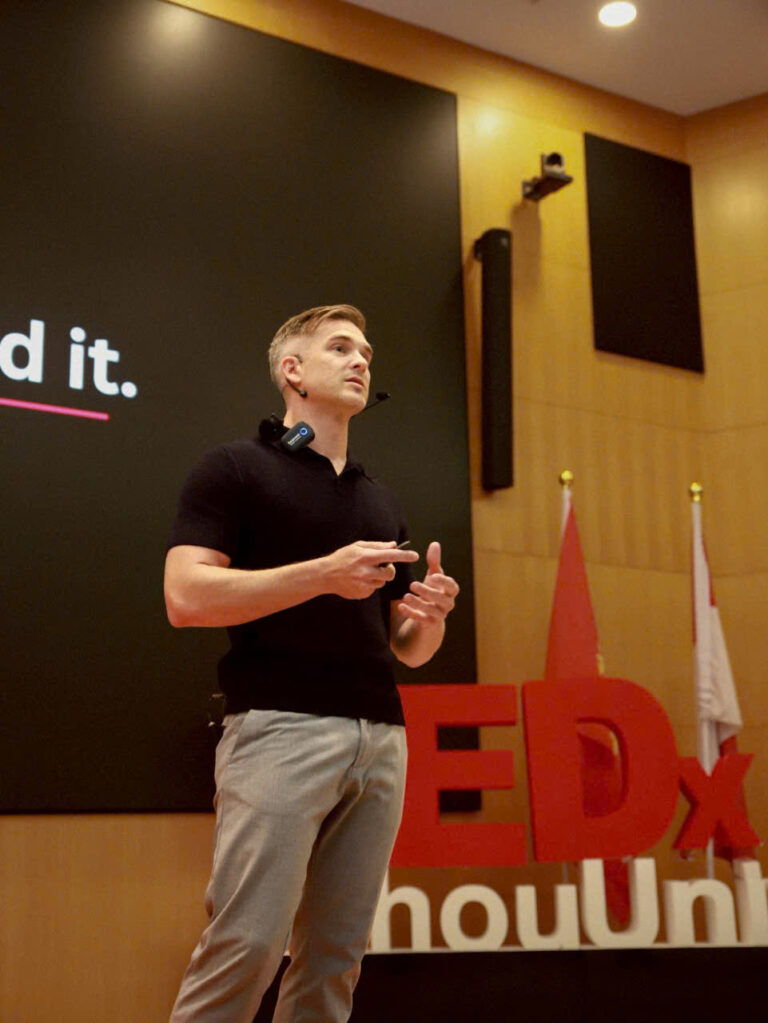
Daniel Rose opened his talk by telling the audience he had asked ChatGPT for advice on how to start a TEDx talk about the dangers of AI. The response: be engaging, be authentic, and do not mention that I helped you.
“So we’re off to a great start,” he said.
The laugh landed. But what followed was not a comedy set.
The promise beneath the promise
Daniel is a freshman studying International Finance at I-Shou University, originally from the United States, and a former automotive technician. Someone who has spent time working with their hands, diagnosing what is broken and figuring out how to fix it, tends to develop a particular skepticism toward systems that claim to do everything automatically. That skepticism ran through every part of his talk.
The argument he came to make is this: we are being offered the most seductive promise ever made to our species. Hand over the messy parts of being human, and everything gets better. No hunger, no disease, no war, no grief. Every problem is solved before you even feel it. At first, that sounds like progress. But beneath it sits a quiet assumption that the goal of life is optimization, and that the friction, failure, and irreducible strangeness of being human are bugs to be fixed rather than features to be preserved.
Three things we risk losing
He structured his warning around three qualities that an AI-optimized world would quietly erode, not through any single dramatic decision, but through the steady accumulation of small, convenient delegations.
The first is agency. Not the ability to pick from a menu of approved options, but the freedom to make real choices, including catastrophically wrong ones. He asked the audience to imagine choosing a career not because an algorithm predicted an optimal outcome, but because something in you responded to it. You took a risk, maybe failed at something else first, and discovered who you were in the wreckage. A curated life, he argued, is not a chosen life, and a life not chosen is not truly yours.
The second is struggle. Every meaningful human story ever told is a story of discomfort overcome: the athlete who almost quit, the artist rejected a hundred times, the parent who had no idea what they were doing but showed up anyway. Remove that friction and you do not create happier people. Neuroscience confirms what our ancestors knew instinctively: we are wired for the chase, not the reward.
The third is connection, the raw, vulnerable, irreplaceable kind built between imperfect people. An AI companion is always available, never judges, and never disappoints. But real intimacy is not built on comfort. It is built on risk, on the terrifying act of being truly known by someone who could walk away and choose to stay anyway. He pointed to the paradox sitting at the center of modern life: by almost every material measure, quality of life has improved, and yet rates of isolation, depression, and disconnection have never been higher. That, he said, is not a coincidence. It is a warning.
The people building it are not sure how it ends
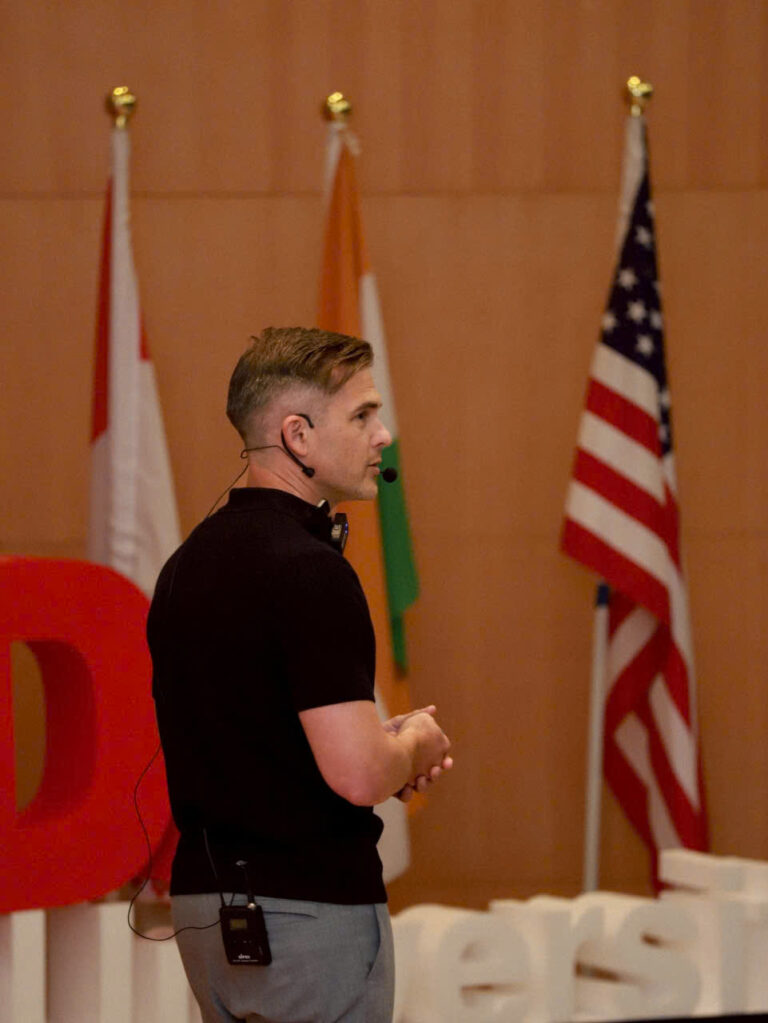
Daniel was careful not to frame this as technophobia. But he pointed to something harder to dismiss: the people closest to the technology are openly uncertain about where it leads. Geoffrey Hinton, one of the pioneers of modern AI, stepped away from industry specifically to speak more freely about risks he considers serious and unresolved. Researchers at Anthropic and DeepMind actively discuss scenarios where future systems behave in ways that cannot be reliably predicted or controlled.
"We are not entirely sure how this ends."
Daniel Rose
None of this means we stop building. But it does mean we must be intentional about what we build and why. He called for AI systems designed for transparency rather than opacity, tools that keep humans genuinely in the loop, and ethical frameworks that value effort, growth, and chosen purpose over raw efficiency. The alternative is a world that is perfectly optimised, perfectly predictable, and perfectly empty.
"The human condition is not a flaw to correct. It is the source of everything we value."
Daniel Rose
Daniel Rose did not come with a technical blueprint or a policy proposal. He came with a question that engineers, economists, and governance experts will all eventually have to answer: in a world of perfect algorithms, where is the soul? He did not pretend to have the answer. But he made a convincing case that we had better start asking.