

TEDxISU 2026 - Journey for Tomorrow | "The System Isn't Broken, It Just Wasn't Built For You" - Bhumishaa R.S.
In the time it takes to read this blog post, thousands of automated decisions will have already been made about real people: who gets a loan, who moves forward in a job application, what sentence a judge is recommended to impose. Not by humans working alone, but by algorithms. And the most urgent question surrounding that reality, Bhumishaa R.S. argued at TEDxISU 2026, is not how to make those algorithms faster or cheaper. It is who decides how to govern them.
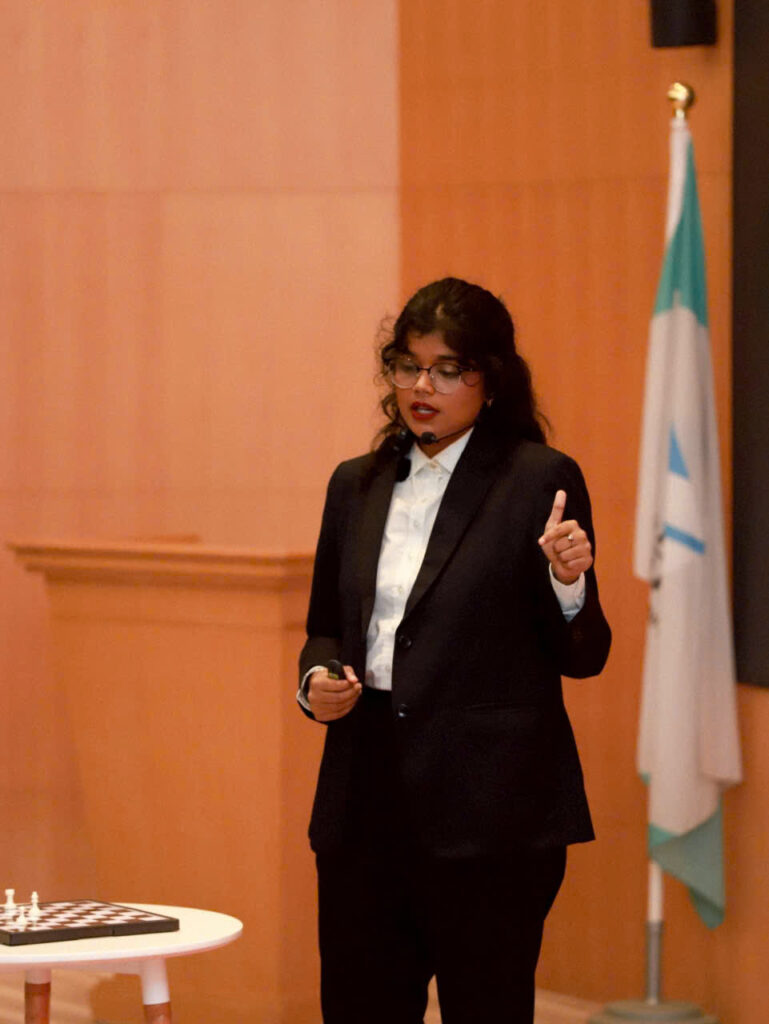
From machine learning to the room where rules are made
Bhumishaa is a junior exchange student from Hindustan Institute of Technology and Science, currently studying the International Program of Artificial Intelligence at I-Shou University. Her background is technical: she has spent years studying how neural networks are trained, how bias enters a dataset at the moment of collection rather than deployment, and why that distinction changes everything about where intervention needs to happen. But her talk was not about building models. It was about governing them.
The pivot from engineering to policy was not a retreat from technical work. It was the direct result of it.
"A model trained on biased data will produce biased outputs. That is a mathematical certainty. But the question of which data is collected, from which communities, with what documentation, those are not engineering decisions. They are governance decisions. And they are made before a single line of code is written."
Bhumishaa R.S.
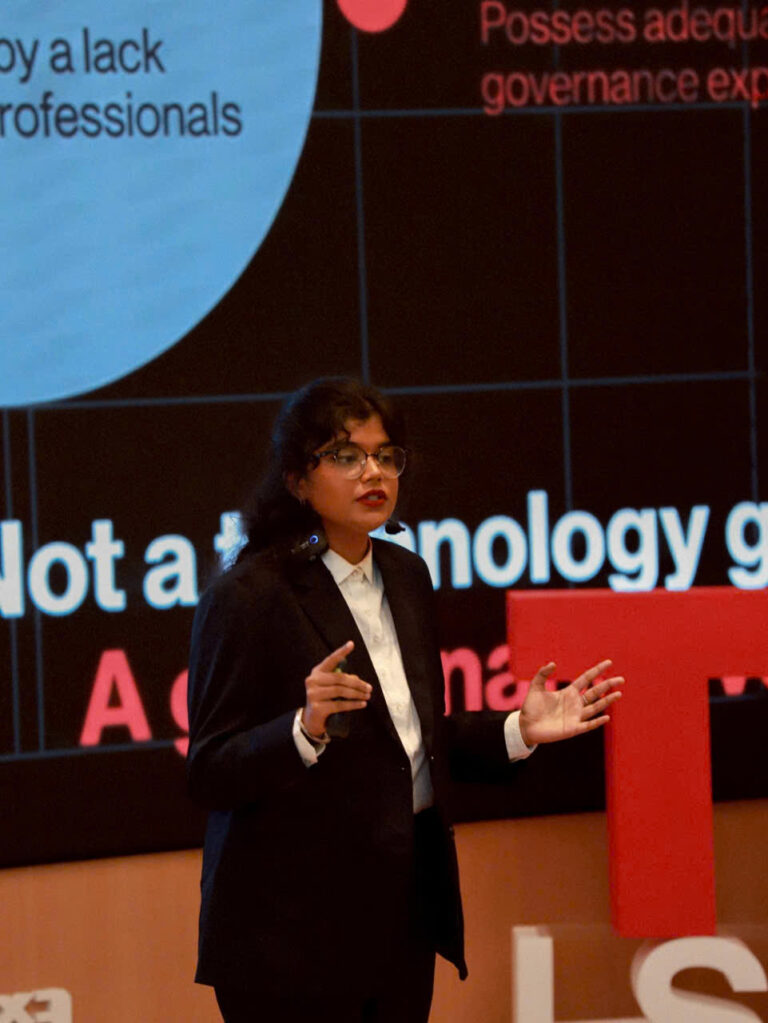
To make the stakes concrete, she put three statistics in front of the room. According to the Stanford AI Index 2026, 78% of global organisations are now deploying AI, up from 55% just one year prior. Yet the IAPP AI Governance Report 2026 found that only 1.5% believe they have adequate governance expertise to manage the systems they are running, and 23.5% cite a lack of qualified people as their primary barrier to responsible AI implementation.
"That is not a technology gap. That is a governance crisis, and it is happening in real time, in the systems that make decisions about real people's lives."
Bhumishaa R.S.
What broken governance actually looks like
Bhumishaa grounded the argument in three documented cases. In 2018, Amazon scrapped an internal AI recruitment tool after discovering it systematically downgraded CVs from women, because it had been trained on a decade of hiring data from a male-dominated industry. That same year, MIT Media Lab research found facial recognition systems showing error rates up to 34% higher for darker-skinned women than for lighter-skinned men. And a ProPublica investigation in 2016 revealed that COMPAS, an algorithm used in US criminal sentencing, incorrectly flagged Black defendants as future criminals at twice the rate of white defendants, reflecting historical disparities baked into the training data from the start.
Every one of these failures has a data governance explanation, and every one could have been identified or legally blocked under Article 10 of the EU AI Act, the world’s first major law governing artificial intelligence, passed in 2024 and already in active enforcement. But laws, she reminded the room, do not enforce themselves.
"Article 10 does not enforce itself. It requires people who can look at a dataset and ask the right questions. People who cannot be told 'the model is compliant' and simply believe it."
Bhumishaa R.S.
Built for those who were never meant to fit
After the policy architecture and the statistics, Bhumishaa made it personal. She described years of feeling like something in her needed correcting to belong in the systems she had been trained for, before understanding that those systems were not broken. They were working exactly as designed, to produce standardised outputs, not to accommodate someone who kept asking who those outputs left out. Her father, she said, built his own room from the ground up.
"When a structure doesn't serve you, you don't break yourself against it. You become the architect."
Bhumishaa R.S.
For international students at I-Shou University navigating institutions not originally built with them in mind, that line landed with particular weight. Bhumishaa ended where she began: steady, direct, and clear about what comes next.
"The system was not built for me. So I am building the room."
Bhumishaa R.S.